The goal of traditional remote sensing systems has been retrieval of surface, subsurface, and above-ground properties of the Earth. Electromagnetic imaging, in general, and radar remote sensing, in particular, are key components of an effective exploration and observation strategy, due to the strong relationships of the measurements with geometric and compositional properties of the observed landscape and object.
Electromagnetic scattering from rough surfaces (e.g., soil, ice) and from random media (e.g., forests) are treated as the building blocks of radar remote sensing. Layered rough surfaces are of particular interest, because they are representative models for many naturally occurring surface and subsurface structures such as layered soil and multi-year ice. Current research within MiXIL is focusing on the development of fast and accurate forward models for electromagnetic scattering by layered random rough surfaces and the corresponding inversion algorithms capable of accurately retrieving the subsurface parameters.
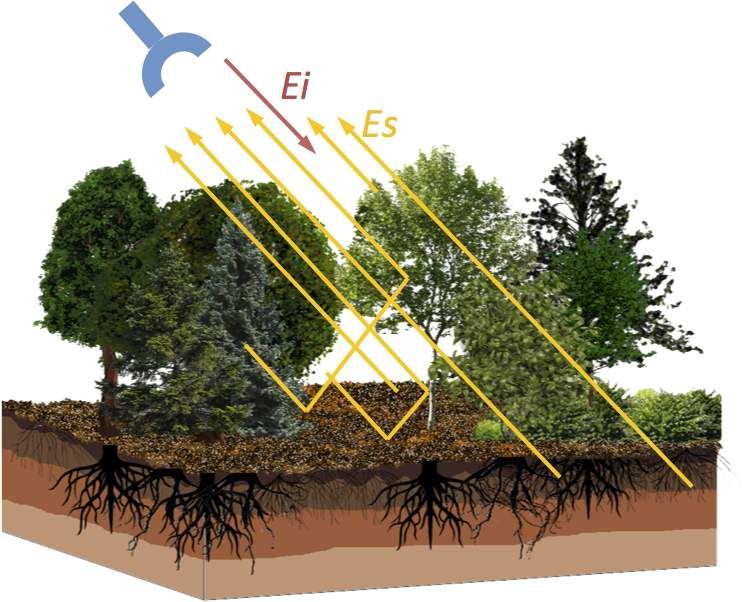
A forward model of scattering from discrete random media representing the root structures and other inhomogeneities is required to study their impact on the evaluation of backscattering cross section. (Duan & Moghaddam, 2011)
Forest Flows Project
A subsurface soil moisture retrieval algorithm, using a pathfinder simultaneously acquired P- and L-band radar data over forested areas, is proposed in Forest Flows project. It employs a generalized radar backscattering model for forests and a second-order polynomial function for soil moisture profile. The inversion uses a hybrid simulated annealing method. The proposed multifrequency retrieval algorithm has been evaluated using both synthetic data and real multifrequency PolSAR data collected from an airborne campaign in Te Hiku, New Zealand, in April 2022. Comparing multifrequency and single P-band retrievals indicated a reduction in RMSE with the multifrequency approach.