Large-scale environmental mapping using satellite radar imagery.
The provision of information on the extent, type, and dynamics of vegetated landcover is critical in a number of applications including, but not limited to, carbon monitoring, biodiversity assessment, situational awareness, and habitat suitability modelling.
Remote Sensing (RS) data, in particular those acquired from spaceborne platforms, offer the ability to provide such information. There has been much research focusing on the use of optical RS data from sensors such as Landsat. Such data are only able to provide information on the vegetation canopy, from which structure must be inferred, and its availability is limited by cloud cover. Synthetic aperture radar (SAR) instruments, in particular those operating at longer wavelengths (e.g., L-band; ~ 25 cm) are able to penetrate the canopy and provide information on vegetation structure. Data acquired from SAR sensors are also unaffected by cloud cover, making them well suited to monitoring applications, especially in areas with near continuous cloud cover such as tropical biomes.
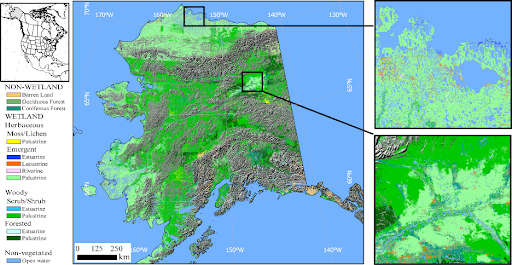
Within MiXIL, our current research has focused on three major biomes; wetlands with study sites North America, wooded savanna with study sites in Queensland, Australia, and artic-boreal regions with study sites distributed across northern Alaska. Key areas of interest are classification, change detection, assessment of satellite calibration/validation sites, and upscaling of subsurface properties.
Automatic Classification
Consistently and accurately extracting information (e.g., vegetation or wetlands classes) from remote sensing data, especially over large areas, requires the development and application of automatic classification methods. Such methods must be flexible and allow the inclusion of ancillary datasets. Current research at MiXIL is investigating Classification and Regression Tree (CART) approaches such as Random Forests, as these have been shown to provide improved accuracy over traditional unsupervised (e.g., ISODATA) and supervised (e.g., maximum-likelihood) methods, especially for spatially extensive data sets.
Change detection
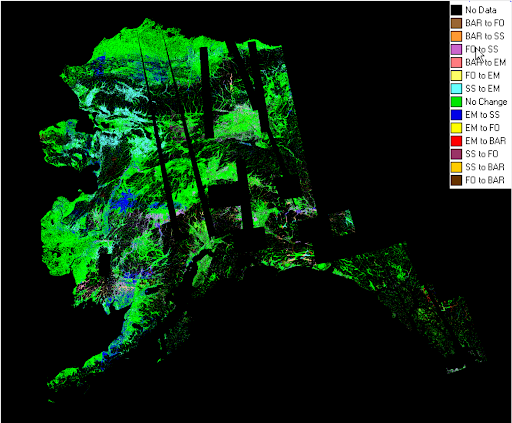
The ability to detect short- and long-term changes is important for quantifying Afforestation, Reforestation and Deforestation (ARD) activities, detecting more subtle changes such as land degradation, and effects of warming and/or drying trends on landcover transitions. However, separating actual change from seasonality, weather effects, classification uncertainty, and instrument error presents a challenge when using remote sensing data from multiple dates. The problem is further complicated when considering data from multiple sensors with different characteristics. Data from different sensors are sometimes poorly aligned with one another, for example, necessitating the implementation of an accurate and efficient multi-modal registration process. Research at MiXIL has focused on ways of quantifying uncertainties associated with change maps.
Assessment of core validation site soil moisture estimates
The NASA Soil Moisture Active Passive (SMAP) mission utilizes sites with permanent networks of in situ soil moisture sensors maintained by independent calibration and validation partners in a variety of ecosystems around the world. Measurements from the permanent network at each core validation site (CVS) are combined in a weighted average to produce estimates of soil moisture at the 33-km scale of SMAP’s radiometer-based retrievals for use in calibration and validation. We have developed an independent method of quantifying the bias in these CVS network soil moisture estimates. It used soil moisture measurements taken from a dense, but temporary, network of soil moisture sensors deployed at each CVS to train a random forests regression expressing soil moisture in terms of a set of spatial variables. The regression was then used as an independent source of upscaled estimates against which the CVS network soil moisture estimates were compared in order to assess biases in the CVS network estimates. Results showed that the magnitude of the uncertainty in the bias of the CVS network estimates can sometimes exceed 80% of the upper limit on SMAP’s entire allowable unbiased root-mean-square error (ubRMSE).
Upscaling of subsurface properties
Extensive, detailed information on the spatial distribution of active layer thickness (ALT) in northern Alaska and how it evolves over time could greatly aid efforts to assess the effects of climate change on the region. We have consequently developed high-resolution maps of ALT throughout northern Alaska. The maps are produced by upscaling from high-resolution swaths of estimated ALT retrieved from airborne P-band synthetic aperture radar (SAR) images collected for three different years. The upscaling was accomplished by using hundreds of thousands of randomly selected samples from the SAR-derived swaths of ALT to train a machine learning regression algorithm supported by numerous spatial data layers. In order to validate the maps, thousands of randomly selected samples of SAR-derived ALT were excluded from the training in order to serve as validation pixels; error performance calculations relative to these samples yielded root-mean-square errors (RMSEs) of 7.5–9.1 cm, with bias errors of magnitude under 0.1 cm. The maps were also compared to ALT measurements collected at a number of in situ test sites; error performance relative to the site measurements yielded RMSEs of approximately 11–12 cm and bias of 2.7–6.5 cm. These data are being used to investigate regional patterns and underlying physical controls affecting permafrost degradation in the tundra biome.
Using an approach similar to that used to map ALT, we are currently working to develop maps of Soil Organic Carbon (SOC) in northern Alaska by upscaling from high-resolution swaths of estimated SOC retrieved from airborne P-band SAR imagery.
Global soil moisture forecasts via deep learning for spacecraft constellation scheduling
Modelling and prediction of geophysical states that have complex spatiotemporal structural characteristics and are influenced by meteorological conditions is a challenging task. These states often have a high degree of spatial and temporal heterogeneity, such that a mathematical model cannot be practically used for their estimation with high accuracy. In this work, we take advantage of recent developments in the machine learning domain to predict geophysical states, specifically surface soil moisture, with high fidelity, from antecedent observations and forcing factors like precipitation.
We develop a soil moisture predictor as part of the “Science Simulator” within DistributedSpacecraft with Heuristic Intelligence to Enable Logistical Decisions (D-SHIELD) project. D-SHIELD consists of a suite of software tools designed to plan and schedule spacecraft payloads and operations, with a science use case scenario focusing on improved global surface soil moisture monitoring via various microwave remote sensing assets. The Simulator predicts surface soil moisture and its prediction error, within a finite, but variable, forecast horizon, which enables the D-SHILED constellation planner and scheduler to determine optimum payload and instrument configurations for soil moisture observations. To validate our framework, we produced global soil moisture forecasts at 9 km/3-hour spatiotemporal resolution and compared them with the L4 global soil moisture from the NASA Soil Moisture Active Passive Mission (SMAP).
This project was in collaboration with NASA ARC, MIT, and Texas A&M and funded by the NASA ESTO AIST 2018 program.
Data availability:Please contact Archana Kannan (kannana@usc.edu) for data and code availability.
Downscaling soil moisture using microwave Active/Passive Data and Deep Neural Nets
Soil moisture is an essential climate variable that directly influences many hydrological, agricultural, and water-cycle processes. Many satellites have been launched and are still being launched to map soil moisture accurately at a global scale. Motivated by the coarse resolution of existing satellite products, many statistical, physics-based, and machine learning-based methods have been proposed to downscale soil moisture to much finer spatial scales. In this project, we develop a novel deep learning approach that is constrained by the Tau-omega radiative transfer model to enhance the resolution of surface soil moisture. We demonstrate the proposed framework by downscaling Soil Moisture Active Passive (SMAP) L-band brightness temperature with C-band SAR backscattering coefficient imagery from Sentinel-1A/B and subsequently retrieving high spatial resolution (1 km) soil moisture. We validate our framework with upscaled in situ soil moisture measurements.
This project is in collaboration with Foundation for Research and Technology – Hellas (FORTH), Institute of Computer Science, Heraklion, Greece. The project was funded by NASA ROSES-2018 Remote Sensing Theory.
Data availability: Please contact Archana Kannan (kannana@usc.edu) for data and code availability.
Mapping Wildfire Burned Area using GNSS Reflectometry with Machine Learning
Mapping wildfire-burned areas with high spatiotemporal accuracy is vital for various operational, environmental, and meteorological applications. This project develops a new methodology for mapping burned areas using the delay-Doppler maps (DDM) from the NASA GNSS-Reflectometry mission CYGNSS, using a machine learning model. In addition to the nominal mode, we study the capabilities of including high-resolution DDM, which has a lower incoherent integration time than the nominal mode and is derived from the raw intermediate frequency (raw IF) mode of data acquisition. We first analyze second-order textural properties such as dissimilarity, entropy, and correlation of the gray-level co-occurrence matrix (GLCM) calculated from nominal and raw IF DDMs. Then, we use the texture features of DDM along with soil and terrain properties to make binary burned area classifications with various nominal-raw IF training splits. Textural analysis on raw IF DDMs revealed a strong discrimination between burned and non-burned pixels. By including the raw IF DDMs while training, we were able to achieve a 15% improvement in F1 score and Matthew’s correlation, compared to training only with the nominal mode DDM. These results represent the first mapping of wildfire-burned areas using spaceborne GNSS-R raw IF data, and in particular, its combination with the use of higher-order statistics.
This project was in collaboration with NASA ARC, USGS, SJSU, and the University of Michigan, funded by the NASA FireSense Technology program.
Data availability: Please contact Archana Kannan (kannana@usc.edu) for data and code availability.
Publications
- D. Clewley, J. Whitcomb, M. Moghaddam, K. McDonald, B. Chapman and P. Bunting, “Evaluation of ALOS PALSAR data for high-resolution mapping of vegetated wetlands in Alaska”, Remote Sensing, vol. 7, no. 6, pp. 7272-7297, June 2015.
- Clewley, D., J. Whitcomb, M. Moghaddam, and K. McDonald, Mapping the State and Dynamics of Boreal Wetlands using Synthetic Aperture Radar, in Advances in Wetlands Mapping, M. Lang and R. Tiner (Eds.), January 2014.
- Whitcomb, J., R. Chen, D. Clewley, J.S. Kimball, N.J. Pastick, Y. Yi, and M. Moghaddam. 2023. Maps of active layer thickness in northern Alaska by upscaling P-band polarimetric synthetic aperture radar retrievals. Environmental Research Letters 19:014046. https://doi.org/10.1088/1748-9326/ad127f. Associated data: Whitcomb, J., R.H. Chen, D. Clewley, J. Kimball, N.J. Pastick, Y. Yi, and M. Moghaddam. 2024. ABoVE: Upscaled Active Layer Thickness in Northern Alaska, 2014-2017. ORNL DAAC, Oak Ridge, Tennessee, USA. https://doi.org/10.3334/ORNLDAAC/2332.
- J. Whitcomb et al., “Active Layer Thickness Throughout Northern Alaska by Upscaling from P-Band Polarimetric Sar Retrievals,” IGARSS 2022 – 2022 IEEE International Geoscience and Remote Sensing Symposium, Kuala Lumpur, Malaysia, 2022, pp. 3660-3663, doi: 10.1109/IGARSS46834.2022.9883357.
- J. Whitcomb, R. Chen, D. Clewley, Y. Yi, J. Kimball and M. Moghaddam, “Maps of Active Layer Thickness on the North Slope of Alaska by Upscaling P-Band Polarimetric SAR Retrievals,” 2021 IEEE International Geoscience and Remote Sensing Symposium IGARSS, Brussels, Belgium, 2021, pp. 1460-1463, doi: 10.1109/IGARSS47720.2021.9553628.
- J. Whitcomb et al., “Evaluation of SMAP Core Validation Site Representativeness Errors Using Dense Networks of In Situ Sensors and Random Forests,” IEEE Journal of Selected Topics in Applied Earth Observations and Remote Sensing, vol. 13, pp. 6457-6472, 2020, doi: 10.1109/JSTARS.2020.3033591.
- J. Whitcomb et al., “A Method for Assessing SMAP Core Validation Site Scaling Bias Using Enhanced Sampling and Random Forests,” IGARSS 2019 – 2019 IEEE International Geoscience and Remote Sensing Symposium, Yokohama, Japan, 2019, pp. 6174-6177, doi: 10.1109/IGARSS.2019.8899233.
- J. Whitcomb et al., “Method for upscaling in-situ soil moisture measurements for calibration and validation of smap soil moisture products,” 2016 IEEE International Geoscience and Remote Sensing Symposium (IGARSS), Beijing, China, 2016, pp. 1641-1644, doi: 10.1109/IGARSS.2016.7729419.
- J. Whitcomb, M. Moghaddam, K. McDonald, E. Podest, B. Chapman, “Progress on SAR-based mapping and change detection for boreal wetlands of North America”, 2012 IEEE International Geoscience and Remote Sensing Symposium (IGARSS), Munich, Germany, 2012.
- Whitcomb, J., M. Moghaddam, K. McDonald, J. Kellndorfer, and E. Podest, “Mapping wetlands of Alaska from L-band SAR imagery,” C. J. Remote Sensing, vol. 35, no. 1, pp. 54-72, February 2009.
- J. Whitcomb, K. Bakian Dogaheh, Y. Zhao, Y. Yi, J. Du, J S Kimball, and M. Moghaddam. Large-scale Mapping of Soil Organic Carbon in the Northern Alaskan Tundra by Upscaling High-Resolution Swaths of SOC from P-Band PolSAR Imagery, American Geophysical Union Fall Meeting, December 2024.
- J. Whitcomb, R. H. Chen, D. Clewley, and M. Moghaddam. Maps of Active Layer Thickness in Northern Alaska via Upscaling of P-band SAR Retrievals, American Geophysical. Union Fall Meeting, December 2020.
- J Whitcomb, D Clewley, R Akbar, A Silva, A Berg, J Adams, T Caldwell, and M Moghaddam. Verification of Regression-Based Upscaling Technique for Calibration/Validation of Space-Based Soil Moisture Products with Sparse in situ Data, American Geophysical. Union Fall Meeting, December 2016.